
"Rare clarity of thought… impactful for anyone trying to learn physics."
— Ashish Shekhar, Head of Content, Khan Academy
The Complete Equation Reference — All 8 Units
What makes this different
- Every equation, paired with its trap. Not just the formula, but the exact way it gets misapplied on FRQs, in its own column so you can't miss it.
- Conditions, not just equations. K is conserved only in an elastic collision. ΔU = mgΔh works only near Earth's surface. Every equation says when it applies and when it breaks.
- A toolkit for every unit. Which equation to reach for, how to read the unit's graphs, and the mistakes to check before you submit.
- Algebra only. Matched to the current AP Physics 1 course. No calculus, nothing outside what's tested.
How to use it
- Before the exam. Work through all 8 units a week or two out and catch every trap before it costs you.
- While you practice FRQs. Keep the unit open and check your answer against the condition, not just the equation.
-
Quick lookup. Ten separate PDFs: the 8 units, the exam technique guide, and one combined file. Open the unit you need and go.
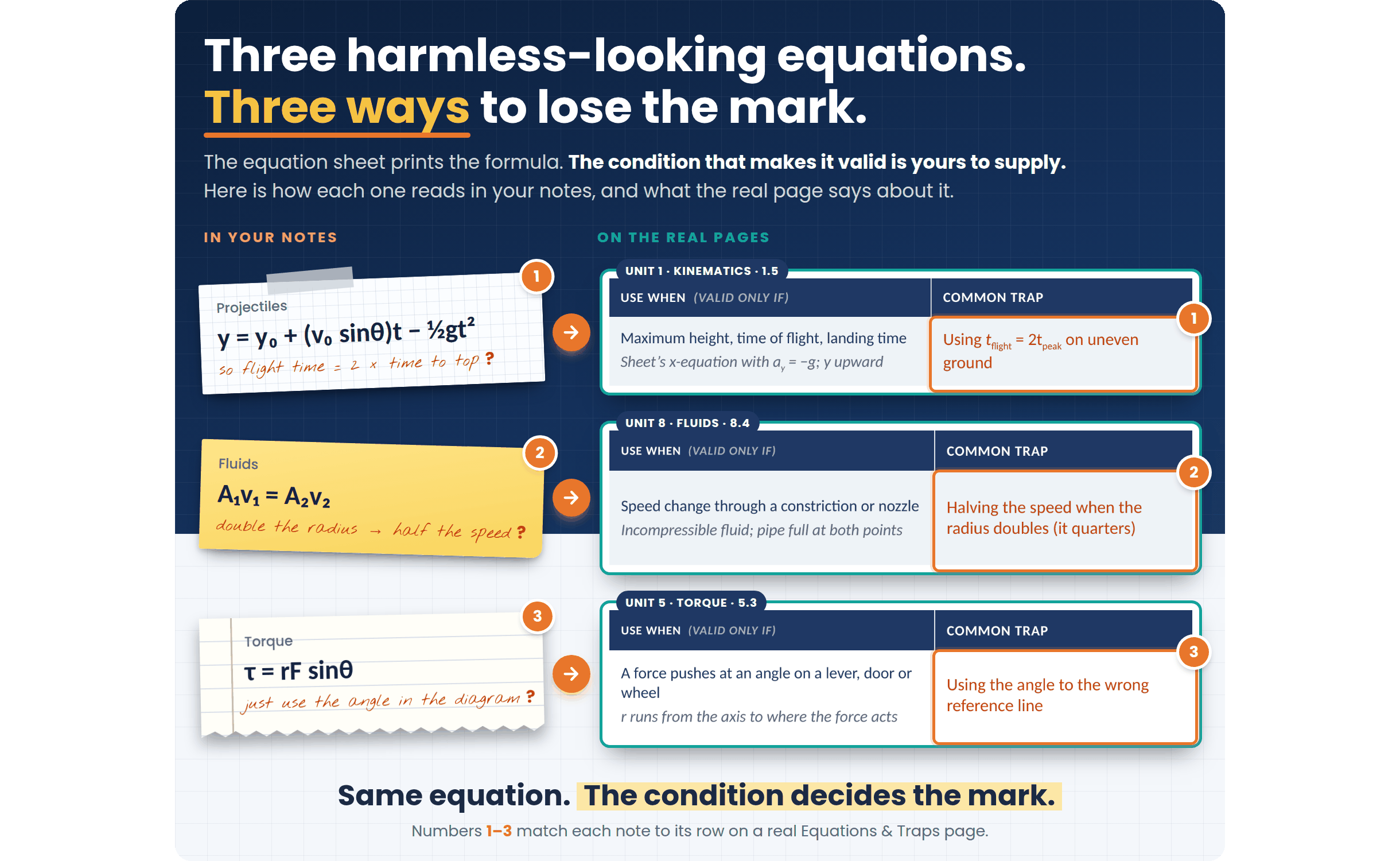
AP Physics 1 equations are not what they look like
The equation sheet gives you every formula. It never tells you when a formula applies, what it really means, or where it quietly breaks. That hidden condition is where AP Physics 1 marks are lost
Here's how it looks like on a real page
(Click image to download the pdf)
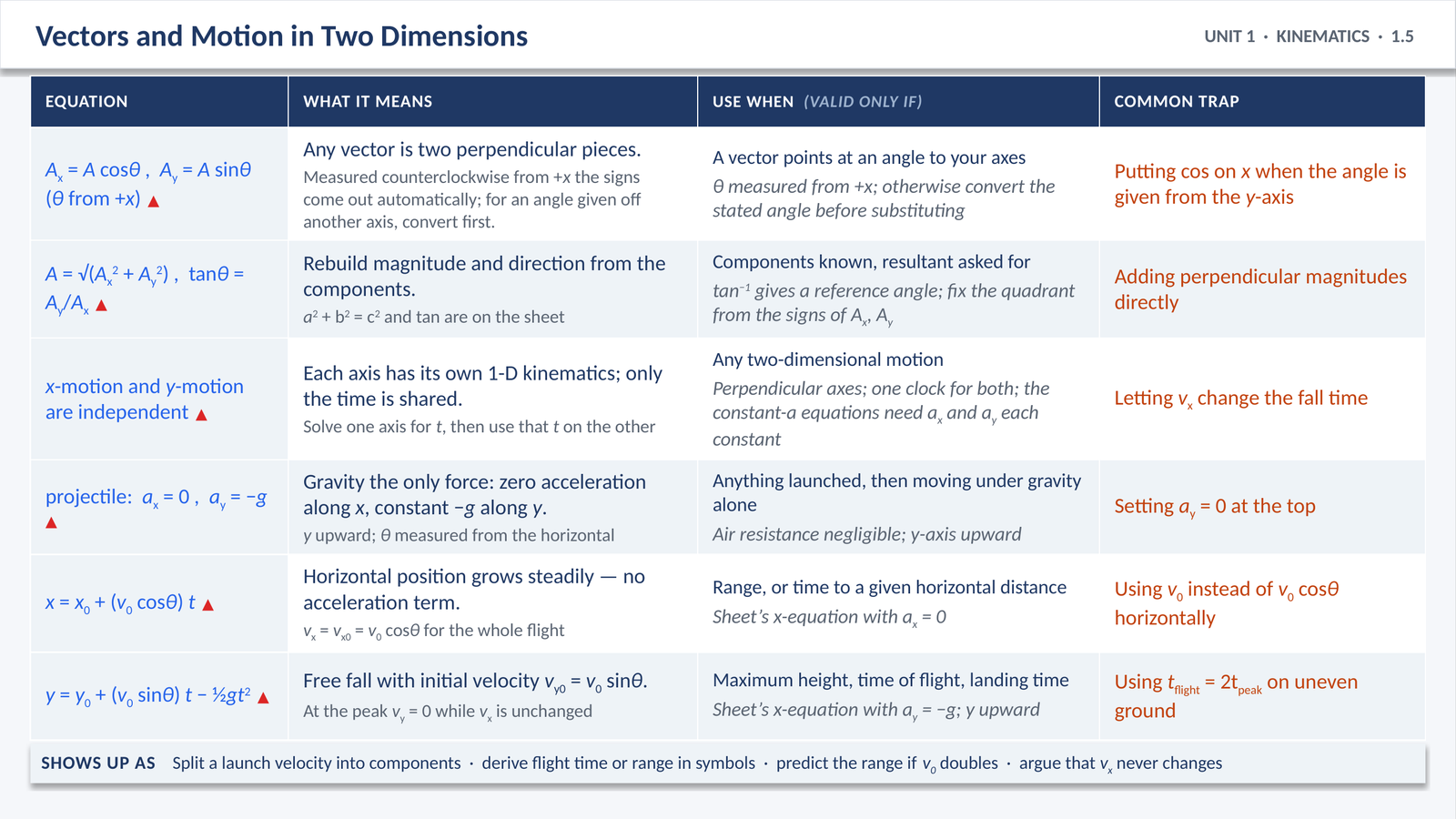
UNIT 1 · TOPIC 1.5
In projectile motion, the horizontal and vertical motions share only the time. On this page, every equation sits beside the condition it needs and the mistake students make when they skip it.
Look for:
Row 5: using v₀ where v₀cosθ belongs. It's the most common slip in range questions.
Row 6: doubling the time to the peak gives the flight time only when the launch and landing heights match.
Why this quietly costs marks
Students rarely lose AP Physics 1 points for forgetting an equation, because most are printed in front of them. They lose them by using it where it doesn't apply.
Everyone gets the same equation sheet. So it can't give you an edge. What sets you apart is knowing where each equation stops working.
Right equation, wrong condition. An equation used outside its condition doesn't earn the point, however clean the algebra that follows.
The graph is marked on its own. If your sketch contradicts the physics, it loses its points even when the equation beside it is correct.
This term vanishes on level ground
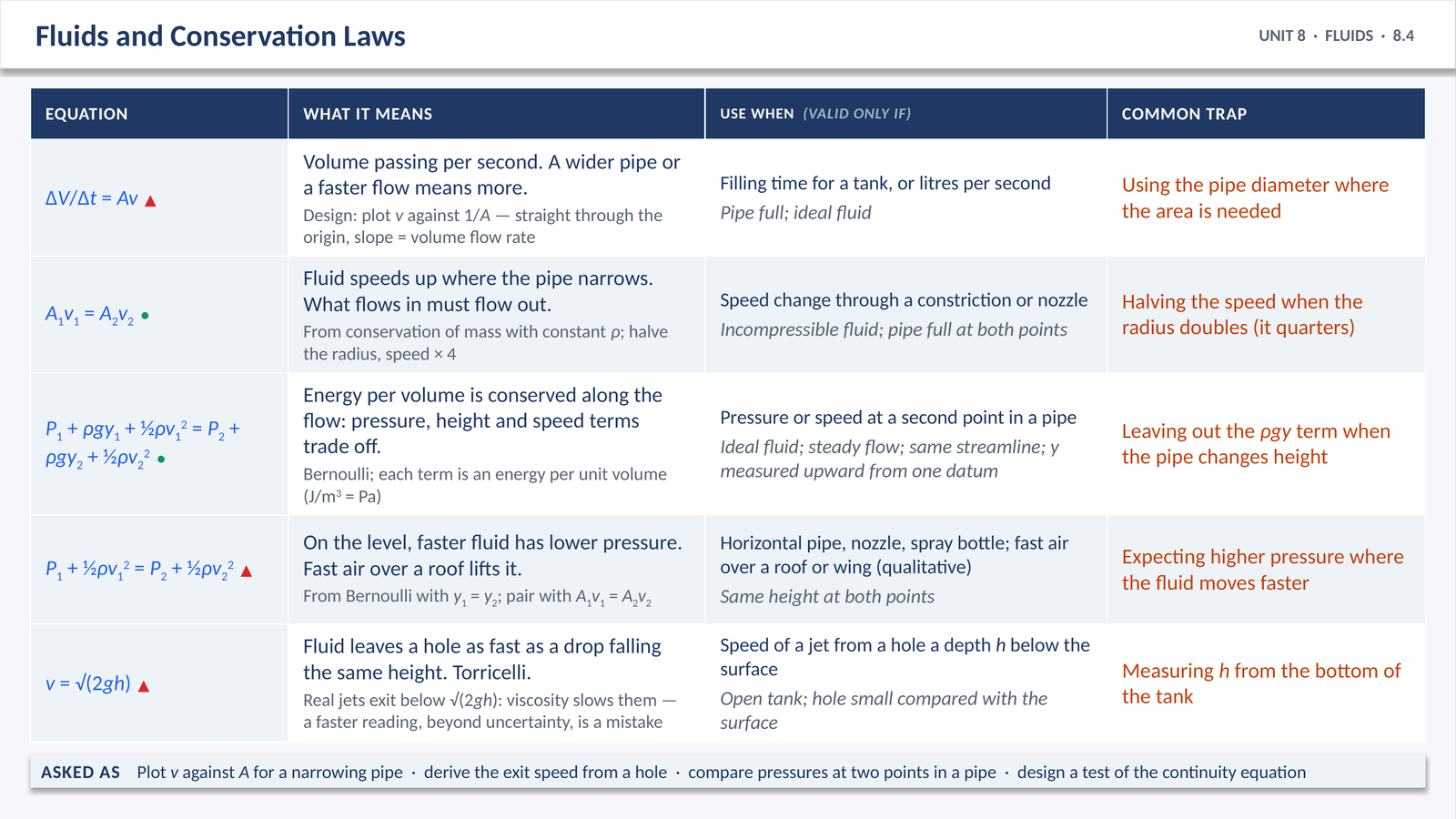
UNIT 8 · TOPIC 8.4
Bernoulli's equation keeps its ρgy term whenever the two points are at different heights. Drop it too early and every number after it is wrong.
Look for:
Row 2: double the radius, the speed drops to 1/4th, not 1/2.
Row 5: in v = √(2gh), h is measured down from the surface, not up from the bottom of the tank.
— 🙠 —
Read the graph, not just the equation
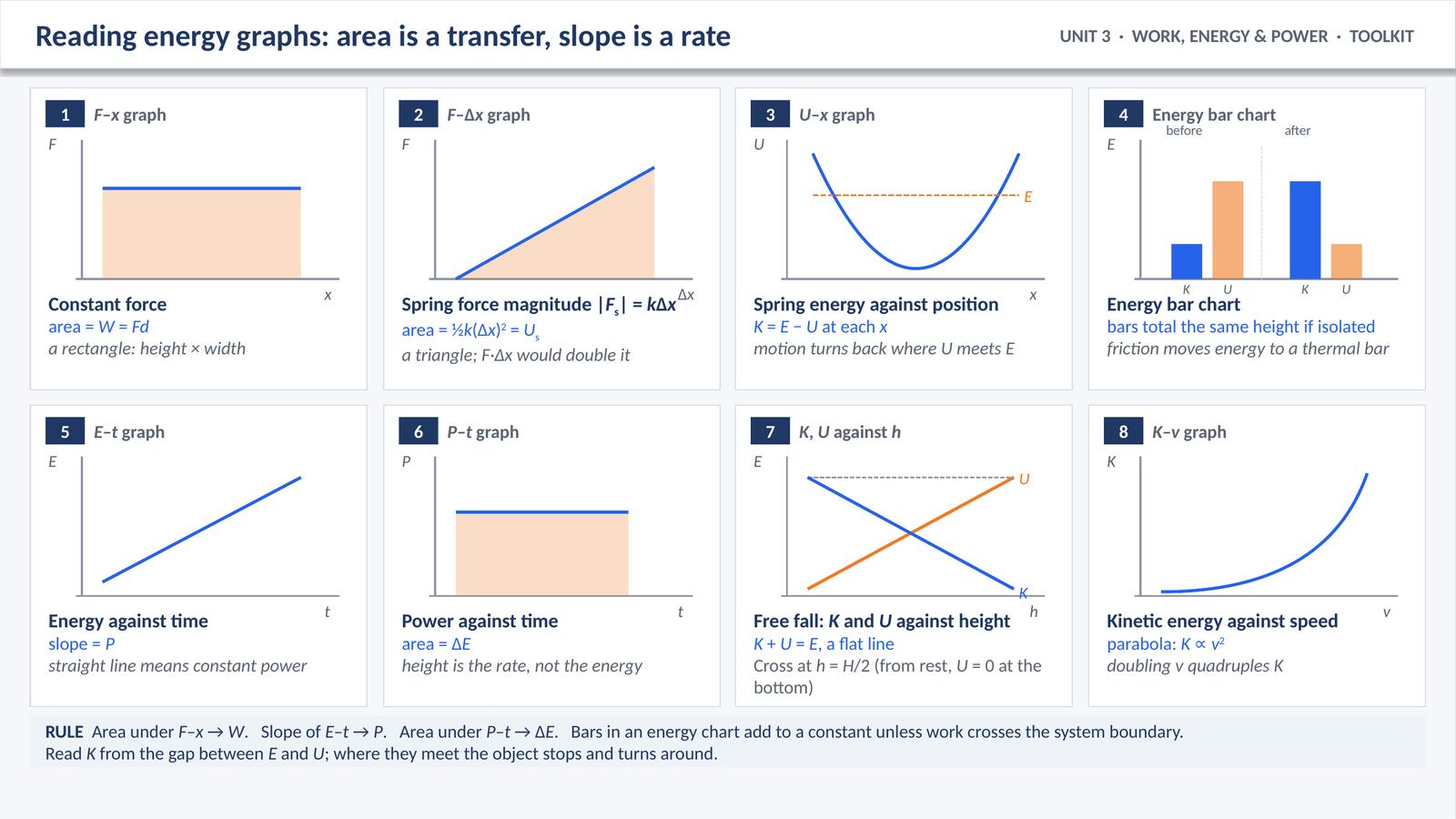
UNIT 3 · SAMPLE TOOLKIT PAGE
On an energy graph, the area under the curve is a transfer and the slope is a rate. Mix them up and a correct equation still gives a wrong answer.
Look for:
Panel 2: the area under a spring's F–Δx graph is ½k(Δx)². Using F·Δx doubles it.
Panel 6: the height of a P–t graph is a rate, not an energy. The energy is the area.
— 🙠 —
Even the right equation can score zero
FRQ points are awarded part by part. Knowing how they're awarded changes what you write down
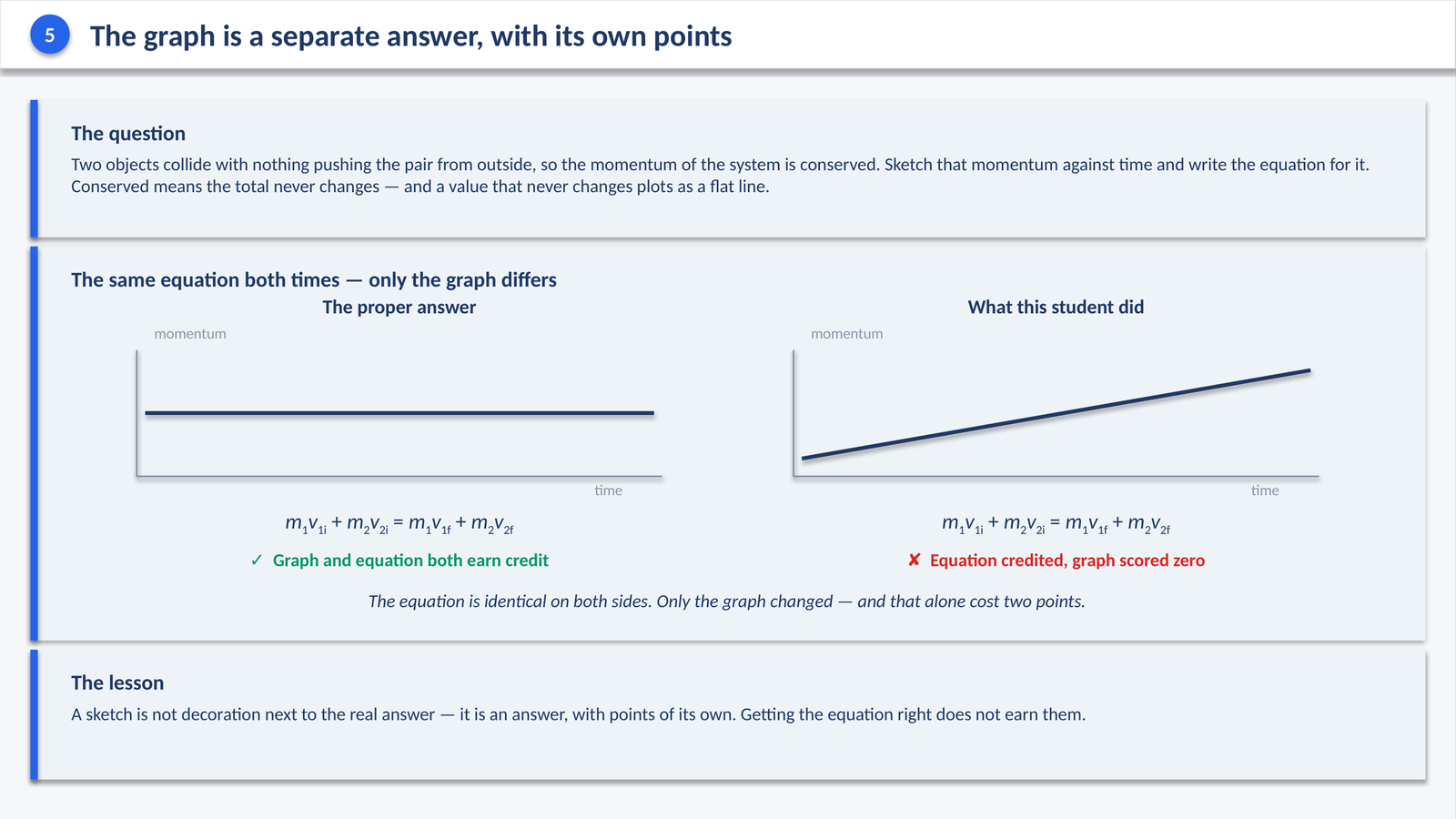
The graph is a separate answer
FRQ TECHNIQUE
A correct equation beside the wrong sketch still loses the sketch's points. Momentum that is conserved plots as a flat line.
— 🙠 —
—~—
FAQ
Is the AP Physics 1 equation sheet enough to do well?
No. The equation sheet gives you the formulas but not the conditions under which they apply, what they mean physically, or where they break. Points are lost when a correct equation is used in the wrong situation, such as doubling the time to the peak when the launch and landing heights differ.
What is a "trap" in AP Physics 1?
A trap is an equation used outside the condition it needs. For example, Bernoulli's equation only loses its ρgy term when both points are at the same height, and τ = rF sinθ only works with the angle between the force and the line from the axis to where the force acts.
Which equations are not printed on the AP Physics 1 equation sheet?
Several relationships you'll use aren't printed in the form you need. Examples are the projectile forms x = x₀ + (v₀cosθ)t and y = y₀ + (v₀sinθ)t − ½gt², Torricelli's v = √(2gh), and the volume flow rate ΔV/Δt = Av. You build these from the physics. The full reference marks every equation ● (printed) or ▲ (not printed).
Does a wrong answer in part (a) cost me the whole FRQ?
No. Later parts of an AP Physics 1 free-response question are graded against your own earlier answer, so a mistake costs only that part. Carry your value forward and say so, for example "using my value of v from part (a)".
Is a graph marked separately from the equation on an FRQ?
Yes. A sketch is its own answer with its own points. A correct equation doesn't rescue a graph that contradicts the physics. For example, conserved momentum must plot as a flat line against time.
Can I see it before I buy?
Yes. The eight pages above are real pages from the full reference, exactly as they appear in the PDF, not mock-ups. If you'd like them as a PDF, download the free 8-page sample. No card is required.
What exactly do I get?
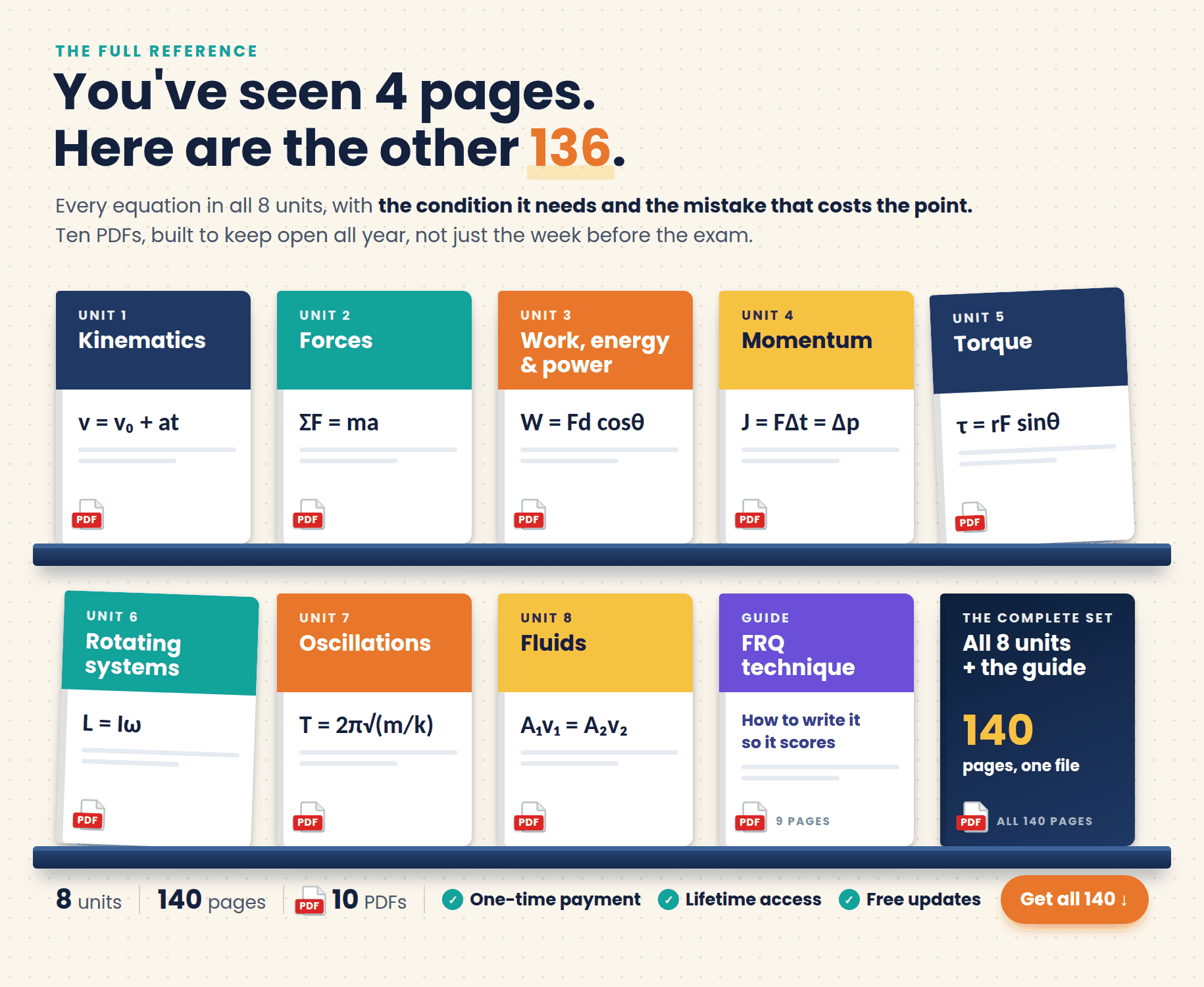
Ten PDFs: one per unit (8), the 9-page Exam Technique guide, and one compiled file with all 140 pages in a single document for searching. Every equation comes with its meaning, its validity condition and its common trap, plus per-unit toolkits for choosing the equation, reading graphs and checking your answer. It costs $29, paid once.
Is this the current curriculum?
Yes. It's built against the current College Board AP Physics 1 framework, all 8 units including Fluids. Pure algebra, no calculus, nothing outside what's tested.
Can I print it?
Yes. The pages are designed landscape, so they print cleanly two-up or one per sheet. Print the units you're working on and keep the rest on your phone.
Does it work on a phone?
Yes. The tables are built to be read on a screen. Keep the unit open beside your problem set.
Do I still need a prep book?
Probably, and that's the point. This isn't a practice-test book. It's the reference you keep open while you work problems, the one that tells you when an equation applies and how it gets misused. Use it alongside whatever practice material you already have.
Will I get updates?
Yes, free, forever. Unit 8 Fluids was added after launch and existing buyers got it at no cost. Anything I add later reaches you the same way.