"Nobody actually understands how helpful it is in reality. Nobody explains the whys — we are forced to be good exam takers. Thanks for making me understand this concept"
— Alduro Ckhesrov, AP Physics 1 Student
THE VISUAL SYNTHESIS BUNDLE
26 PDFs (Mind Maps + Concept Busters)
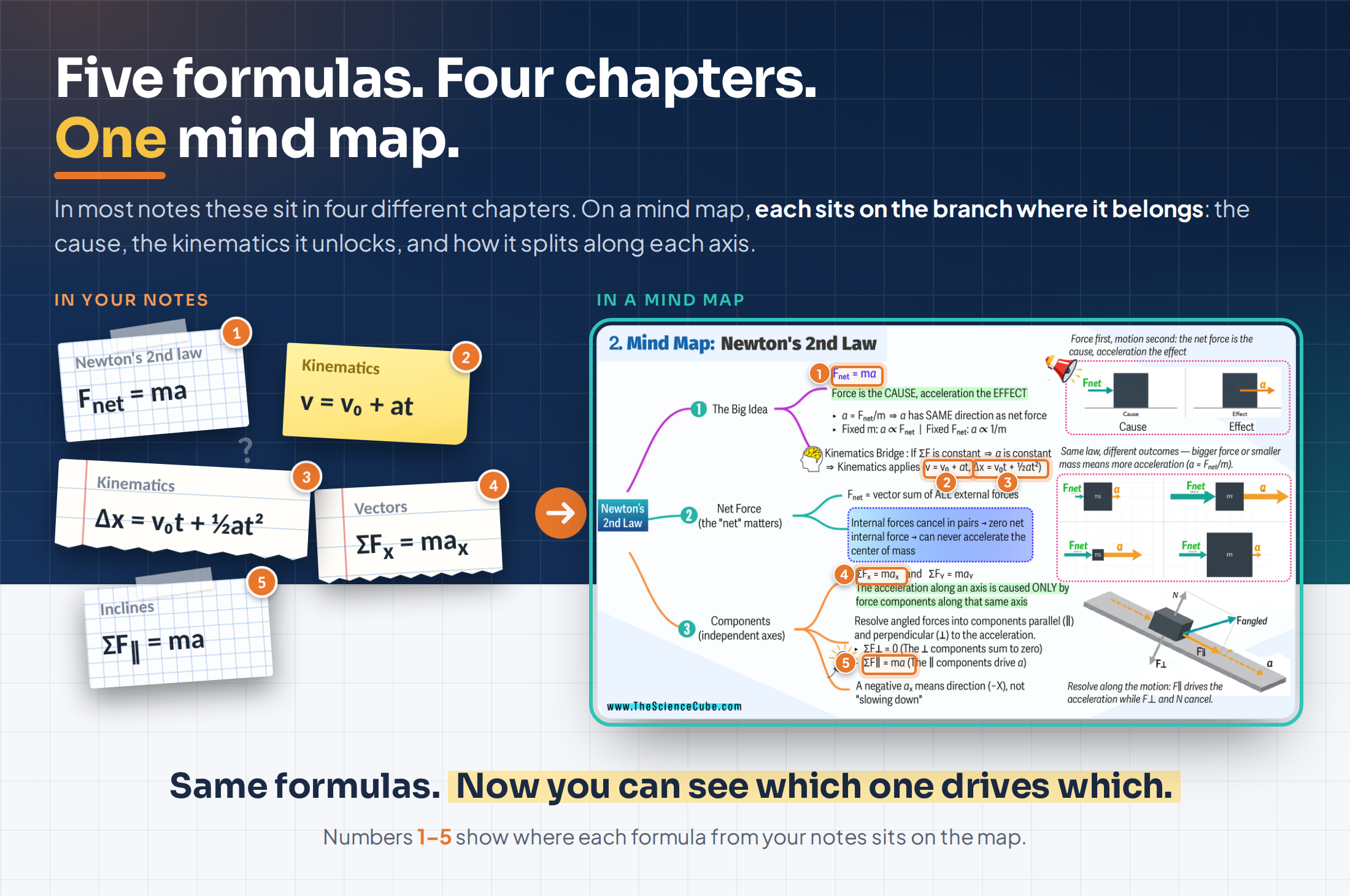
Knowing the formulas isn't the problem. Seeing which idea drives which, and following that chain through a paragraph-length problem, is what separates a 4 from a 5.
Students lose FRQ points when they treat each topic as its own chapter. They solve for acceleration without asking what force caused it, or apply a kinematics equation to motion where the net force keeps changing. The exam is written to test exactly those links.
Each mind map lays out one topic on a single page: the central idea, what it depends on, what follows from it, and the proportional relationships the exam likes to ask about.
What Makes This Different
- Concepts Drawn as Connections. See how force sets acceleration, how acceleration drives the kinematics, and where one topic hands off to the next.
- Proportional Reasoning Built In. Relationships like a = v²/r ⇒ a ∝ 1/r are written on the map itself, so "what if r doubles?" questions take seconds.
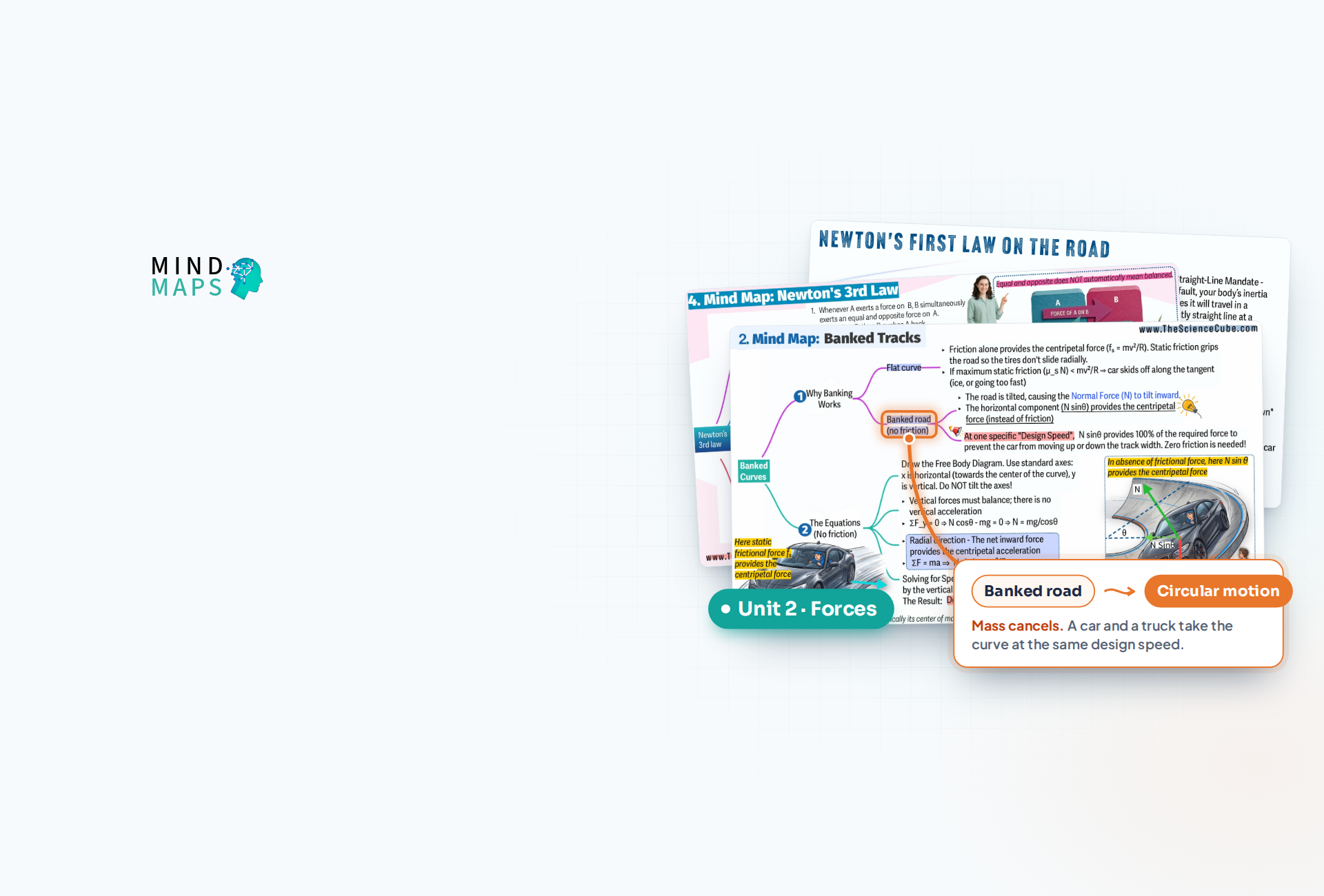
- Concept Busters. One-page illustrated explainers that take a single idea into an everyday scene and walk through it step by step. They cover why ketchup shoots out when you stop the bottle, why you slide toward the door on a turn when nothing pushes you outward, and why a boulder is as hard to stop as it is to start.
- Pure Algebra. Strictly aligned to the current College Board AP Physics 1 curriculum. No calculus, and nothing beyond what's tested.
The Curriculum: Units 1–2
- Unit 1: Kinematics. 1D and 2D motion, projectile paths, motion graphs, and the core equations (Δx = v₀t + ½at²).
- Unit 2: Force & Translational Dynamics. Newton's laws, free-body diagrams, friction, circular motion and gravitation, and net force (F_net = ma).
How to Use This
- Pre-Exam Synthesis. Print both units a month before the exam to pull a year of notes into one framework.
- FRQ Practice. Keep the relevant map open while you work problems, and train yourself to spot the right principle faster.
-
Classroom Companion. Use the maps alongside daily lessons to see where each new idea fits.
These are real pages, not mock-ups
Five pages from the bundle, exactly as they appear in the download: two mind maps and three Concept Busters, across both units 👇
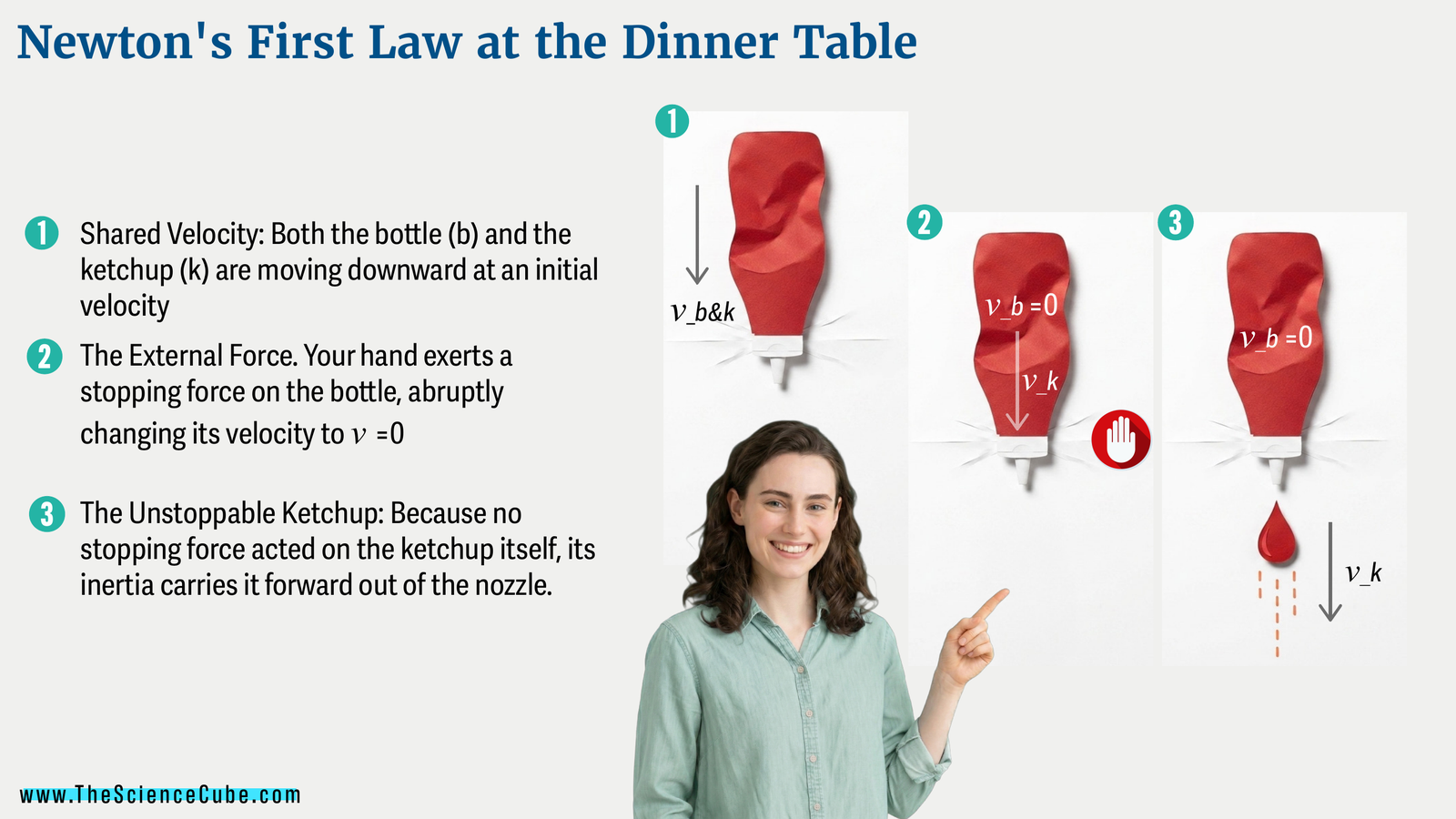
Why the ketchup keeps going
UNIT 2 · FORCES · CONCEPT BUSTER
The bottle and the ketchup move down together. Your hand stops the bottle, but nothing stops the ketchup inside, so it keeps moving and leaves the nozzle.
Look for:
Panel 2: the stopping force acts on the bottle only.
Panel 3: the bottle's velocity is zero while the ketchup still has v_k.
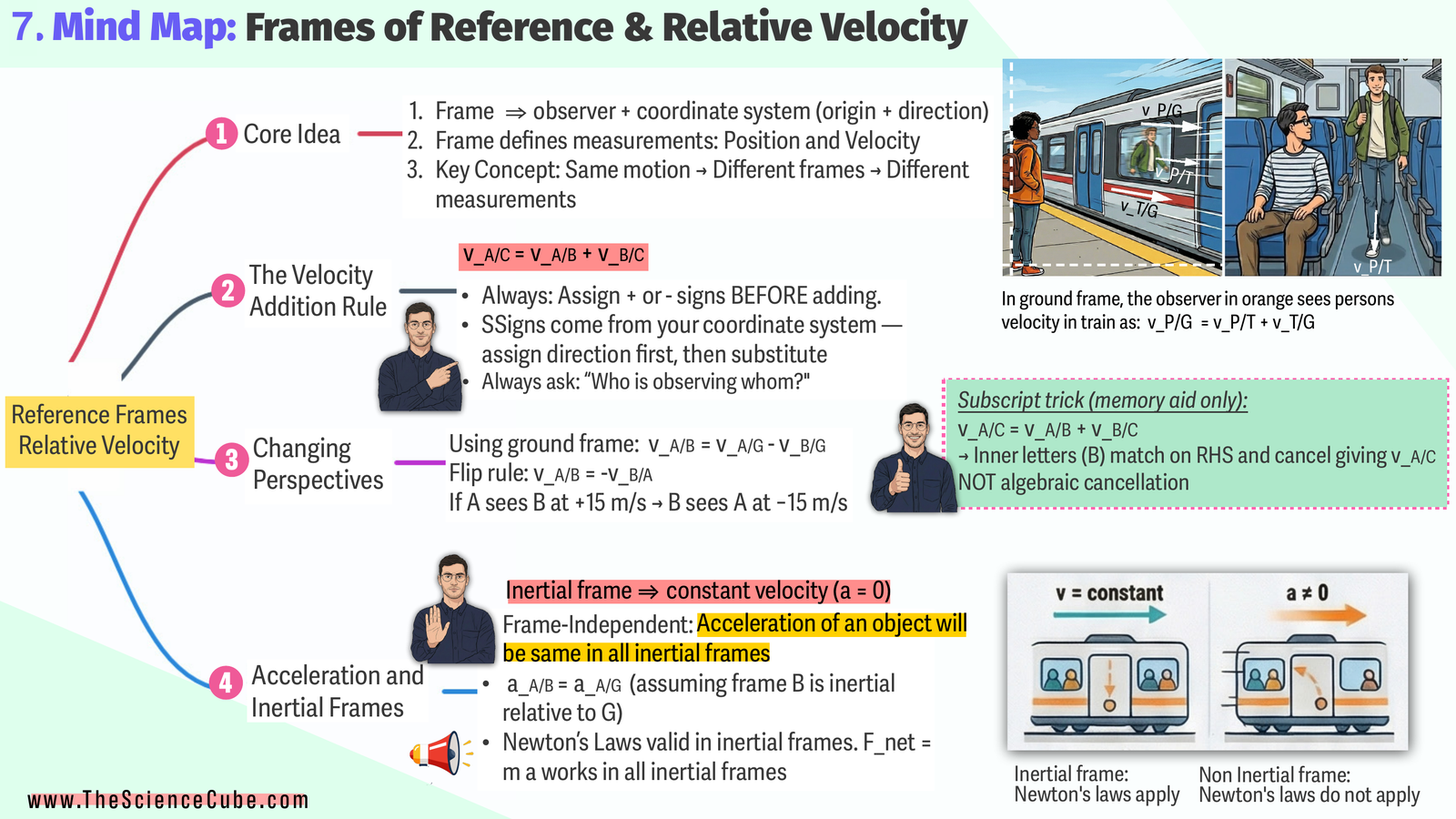
Who is observing whom?
UNIT 1 · KINEMATICS · MIND MAP
The same motion gives different velocities in different frames. This map ties the addition rule, the flip rule and inertial frames to one train scene.
Look for:
Branch 2: v_A/C = v_A/B + v_B/C, with signs assigned before you add.
Branch 4: acceleration is the same in every inertial frame, so Newton's laws work in all of them.
Area is a change, never the final value
UNIT 1 · KINEMATICS · MIND MAP
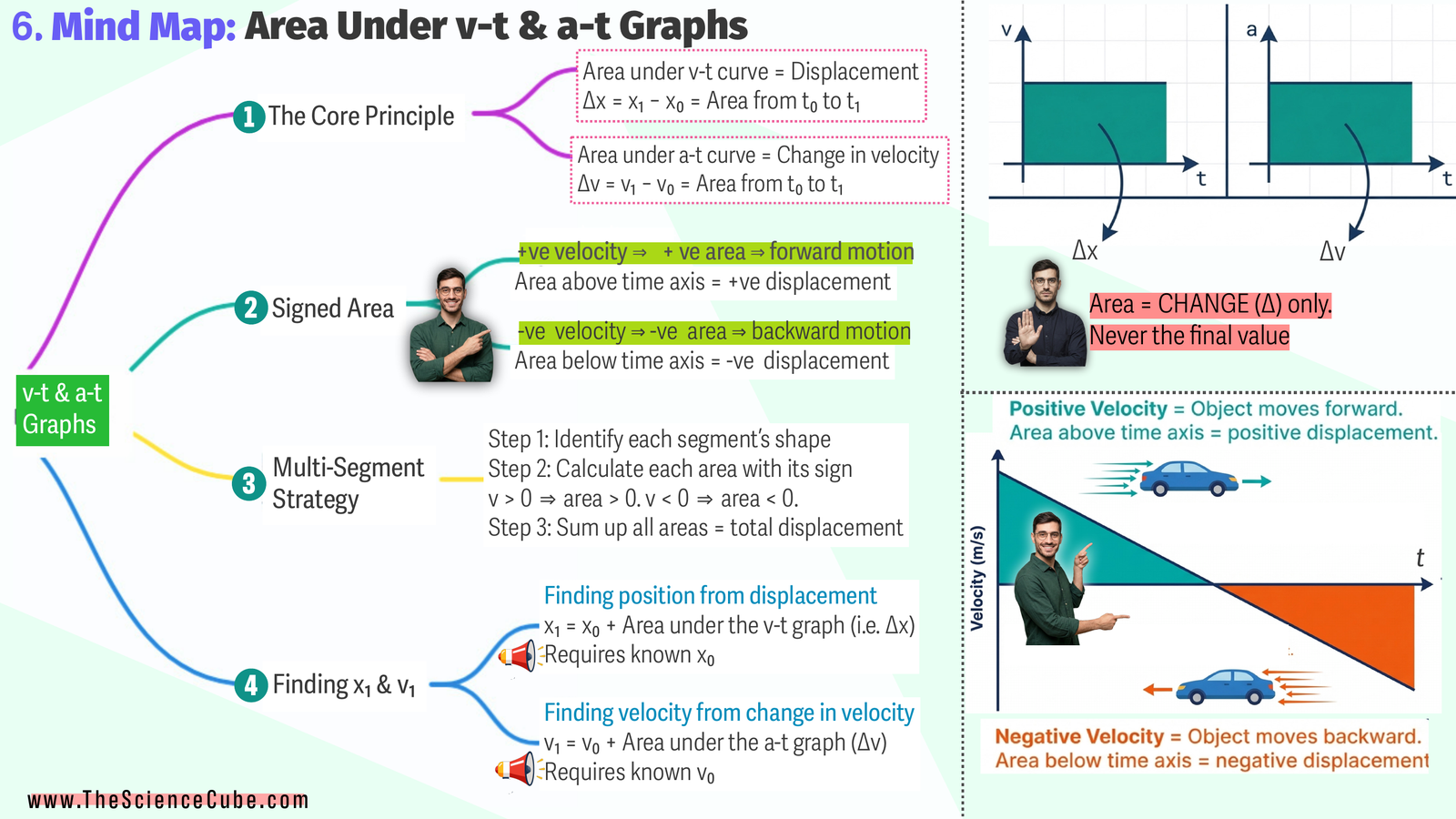
The area under a v-t graph is displacement. The area under an a-t graph is the change in velocity. Neither one gives the final value on its own.
Look for:
Branch 2: area below the time axis is negative displacement. That's the car reversing.
Branch 4: x₁ = x₀ + area, so you need the starting position to find where it ends up.
Negative acceleration doesn't mean slowing down
UNIT 1 · KINEMATICS · CONCEPT BUSTER
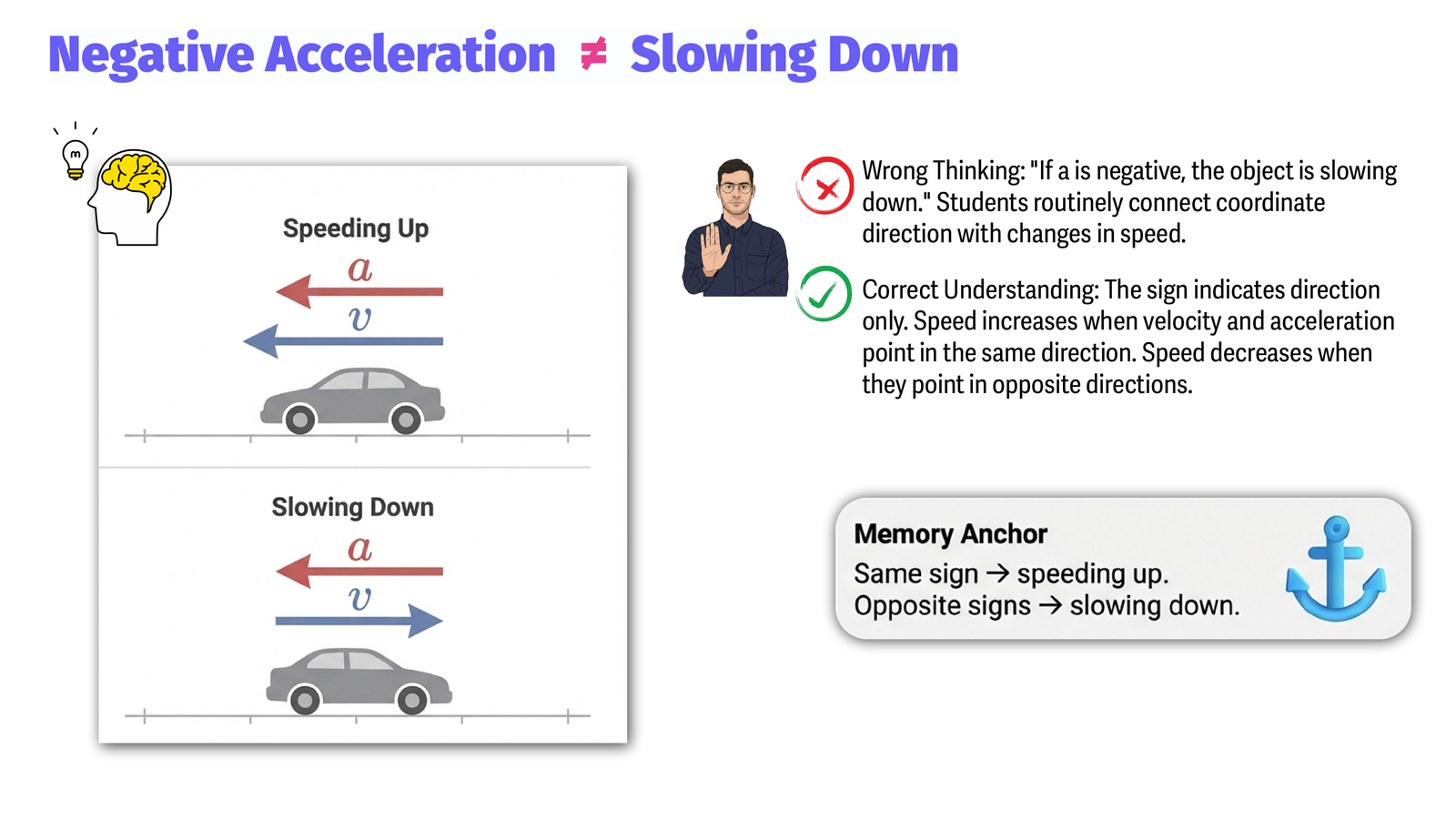
The sign of a tells you its direction, not whether the object is speeding up or slowing down.
Look for:
Top car: a and v are both negative, and it's speeding up.
The memory anchor: same signs mean speeding up, opposite signs mean slowing down.
Static friction matches your push, up to a limit
UNIT 2 · FORCES · CONCEPT BUSTER
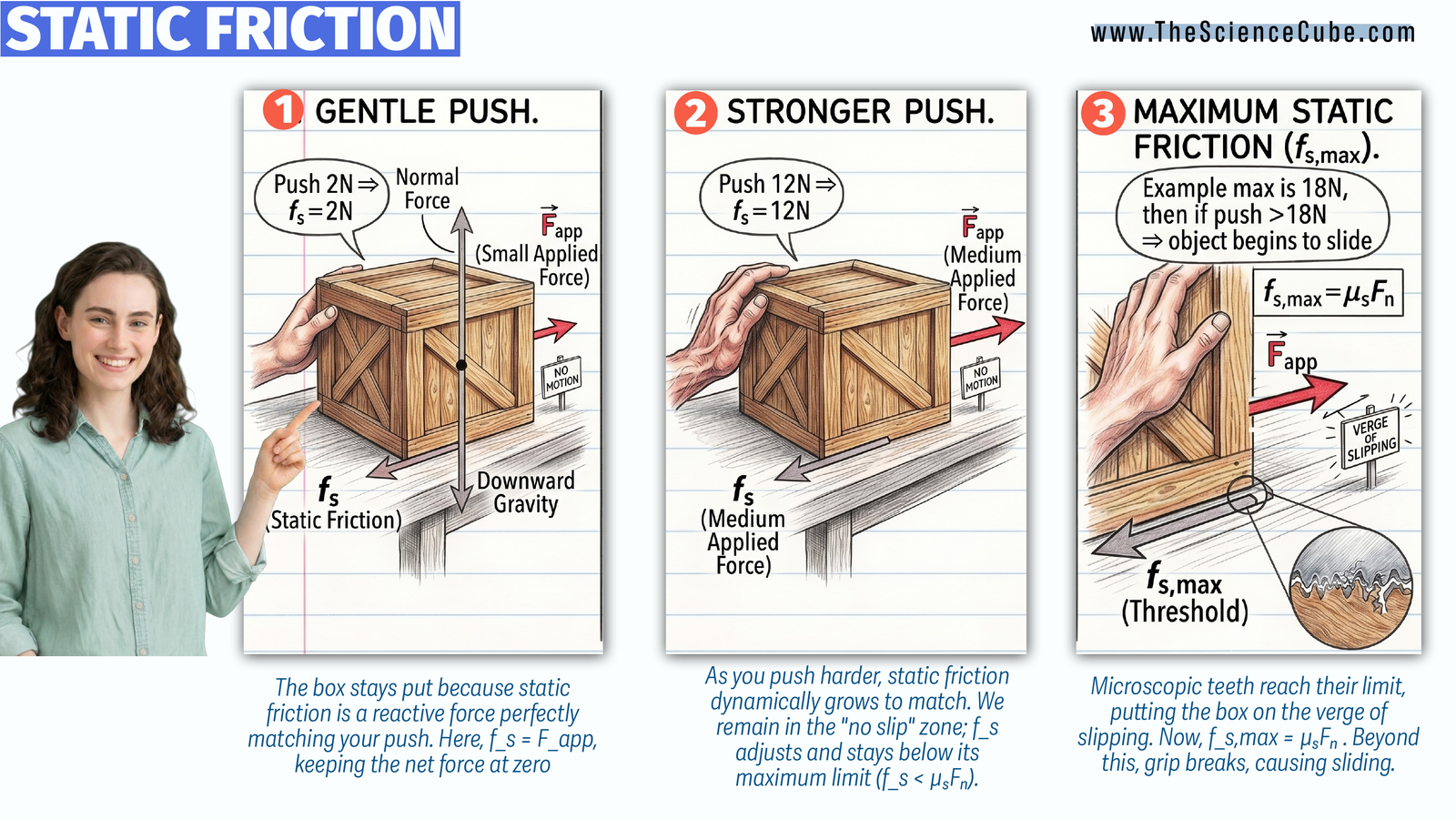
Push harder and static friction grows to match, so the crate doesn't move until friction reaches its maximum.
Look for:
Panels 1 and 2: fₛ equals your push while nothing moves.
Panel 3: fₛ,max = μₛFₙ. Push beyond it and the crate slides.
FAQ
Can I see it before I buy?
Yes. The pages shown above are real pages from the bundle, exactly as they appear in the download.
What exactly do I get?
26 PDFs covering AP Physics 1 Units 1 and 2: Kinematics, and Force and Translational Dynamics. That's 108 pages in all. Each PDF covers one topic, built around its mind map and its Concept Busters. Many also include a key-formulas table, a glossary or a page of common misconceptions.
Will more units be added?
Yes. More units are on the way, and once you're enrolled, each new unit is added to your bundle at no extra cost.
How is a mind map different from a formula sheet?
A formula sheet lists equations one after another. A mind map puts a whole topic on one page and shows how its ideas connect: which idea causes which, when each equation applies, and where students usually slip. You see the path from the free-body diagram to the answer, not just the formula at the end.
What are Concept Busters?
Illustrated one-page explainers built around a real situation: a ketchup bottle, a car taking a sharp turn, a shoe pushing on the floor. The forces and velocities are drawn right on the picture, so you see the physics happening instead of reading about it.
Do I need this if I already have a prep book or class notes?
Your book or notes teach each topic chapter by chapter. The mind maps sit on top of them: one page per topic that shows how everything in it fits together. Use them to revise before a test, or keep one open while you work through problems.
Is this the current AP Physics 1 curriculum?
Yes. It follows the College Board's current AP Physics 1 course framework. It's algebra-based throughout, with no calculus.
Is this a subscription?
No. It's a single $11 payment with lifetime access. A payment plan is also available at checkout.
Can I print it?
Yes. The pages print cleanly on A4 or Letter paper. Many students print the mind maps and keep them in a revision folder.
Does it work on a phone?
Yes. The PDFs open on any phone, tablet or laptop. Because most pages are landscape, they're easiest to read on a tablet or laptop, or printed.