AP Physics 1
Full Course
Videos·Simulations·FRQs·Mind maps
- Unit 1Kinematics
- Unit 2Force & Translational Dynamics
- Unit 3Work, Energy & Power
- Unit 4Linear Momentum
- Unit 5Torque & Rotational Dynamics
- Unit 6Energy & Momentum (Rotation)
- Unit 7Oscillations
- Unit 8Fluids


Hard ideas finally click, and they can solve the questions on their own.
Rare clarity of thought… making even difficult ideas intuitive.
I often integrate his innovative videos into my university lectures.
Thanks for making me an understander of this concept.
What You’ll Learn in This Plan

The Science Cube · Course Map
AP Physics 1: Course at a Glance
Every unit, topic and lesson in the course — laid out the way the College Board maps its own AP Physics 1 exam, with the official exam weighting attached to each unit. The full course is free while it's being built out.
What it is
An algebra-based introductory physics course — equivalent to a first-semester college mechanics course. Prerequisite: Geometry, with Algebra II taken concurrently.
How it's taught
The official framework asks for 25% hands-on, inquiry-based work. On The Science Cube, every lesson meets that through an interactive simulation instead of a lab writeup.
How it's organized
8 units, sequenced the way the College Board's own course framework orders them — the same order used in most college mechanics textbooks.
Exam Weighting — Multiple-Choice Section, AP Physics 1 Exam
| Units of Instruction | Exam Weighting |
|---|---|
| Unit 1: Kinematics | 10–15% |
| Unit 2: Force and Translational Dynamics | 18–23% |
| Unit 3: Work, Energy and Power | 18–23% |
| Unit 4: Linear Momentum | 10–15% |
| Unit 5: Torque and Rotational Dynamics | 10–15% |
| Unit 6: Energy and Momentum of Rotating Systems | 5–8% |
| Unit 7: Oscillations | 5–8% |
| Unit 8: Fluids | 10–15% |
Weighting and pacing reflect the College Board’s official AP Physics 1: Algebra-Based Course and Exam Description (effective Fall 2024). Lesson counts below are The Science Cube’s own breakdown of each topic.
Science Practices — spiral through every unit
Creating Representations
Create diagrams, graphs, and sketches that depict physical phenomena.
Mathematical Routines
Derive, calculate, estimate, or predict using logical mathematical pathways.
Scientific Questioning & Argumentation
Design experimental procedures, analyze data, and justify claims with evidence.
Course at a Glance
Unit1 Kinematics 5 topics · 23 lessons
1.1 Scalars and Vectors in One Dimension 3 lessons
1.1.1 Scalars vs Vectors
- Definition of a scalar quantity
- Definition of a vector quantity
- Examples of scalars in mechanics (mass, time, distance, speed)
- Examples of vectors in mechanics (displacement, velocity, acceleration, force)
- Why direction matters in physics
1.1.2 Representing Vectors in One Dimension
- Sign convention as direction in 1D
- Choosing a positive direction (coordinate axis)
- Vector notation (arrow notation, bold notation)
- Magnitude vs signed value of a 1D vector
1.1.3 Adding and Subtracting 1D Vectors
- Vector addition with sign convention
- Vector subtraction as adding the negative
- Net vector quantity in 1D
- Common student errors with signs
1.2 Displacement, Velocity and Acceleration 5 lessons
1.2.1 Position and Displacement
- Position as a coordinate
- Displacement as change in position (Δx)
- Distance vs displacement
- Sign of displacement and direction
- Displacement over multiple intervals
1.2.2 Speed and Velocity
- Speed as a scalar
- Velocity as a vector
- Average velocity formula and meaning
- Average speed formula and meaning
- Why average speed ≠ magnitude of average velocity in general
1.2.3 Instantaneous Velocity
- Concept of instantaneous velocity
- Velocity as the limit of average velocity over small time intervals
- Instantaneous speed
- Direction of instantaneous velocity
1.2.4 Acceleration
- Acceleration as change in velocity
- Average acceleration formula
- Instantaneous acceleration
- Sign of acceleration vs direction of motion
- Why "negative acceleration" does not always mean slowing down
- Deceleration as a non-physics term
1.2.5 Kinematic Equations for Constant Acceleration
- The four kinematic equations
- When constant acceleration applies
- Choosing the right equation for a given problem
- Free-fall as a special case (g = 9.8 m/s²)
- Sign conventions in vertical motion
1.3 Representing Motion 5 lessons
1.3.1 Position-Time Graphs
- Reading position from a position-time graph
- Slope of a position-time graph as velocity
- Straight line vs curve interpretation
- Reading direction of motion from slope sign
1.3.2 Velocity-Time Graphs
- Reading velocity from a velocity-time graph
- Slope of a velocity-time graph as acceleration
- Area under a velocity-time graph as displacement
- Identifying motion phases (speeding up, slowing down, at rest)
1.3.3 Acceleration-Time Graphs
- Reading acceleration from an acceleration-time graph
- Area under acceleration-time graph as change in velocity
- Constant acceleration vs varying acceleration
1.3.4 Translating Between Graphs
- From position-time to velocity-time
- From velocity-time to acceleration-time
- From acceleration-time back to velocity-time
- Common student misreadings of motion graphs
1.3.5 Motion Diagrams
- Drawing motion diagrams with position dots
- Showing velocity vectors on a motion diagram
- Showing acceleration on a motion diagram
- Using motion diagrams to set up problems
1.4 Reference Frames and Relative Motion 3 lessons
1.4.1 Reference Frames
- Definition of a reference frame
- Choosing a reference frame for a problem
- How motion description depends on the frame
- Inertial reference frames (qualitative)
1.4.2 Relative Velocity in One Dimension
- Velocity of A relative to B
- Velocity addition in 1D
- Same-direction vs opposite-direction motion
- Sign convention in relative velocity problems
1.4.3 Applications of Relative Motion
- Boats in rivers (1D component)
- Vehicles passing each other
- Walking on a moving walkway
- Common reference frame problem types
1.5 Vectors and Motion in Two Dimensions 7 lessons
1.5.1 Vector Representation and Graphical Addition
- Vectors vs scalars in 2D
- Vector notation and magnitude-direction form
- Graphical vector addition (tip-to-tail)
- Graphical vector subtraction
- Parallelogram method
1.5.2 Vector Components and Resolution
- Resolving a vector into perpendicular components
- Sine and cosine for components
- Reconstructing a vector from components (magnitude and angle)
- Adding vectors using components
- Subtracting vectors using components
1.5.3 Position, Displacement, and Velocity Vectors in 2D
- Position vector in 2D
- Displacement vector in 2D
- Average velocity vector in 2D
- Instantaneous velocity vector (tangent to path)
- Difference between distance traveled and displacement magnitude
1.5.4 Acceleration Vectors in 2D
- Acceleration vector in 2D
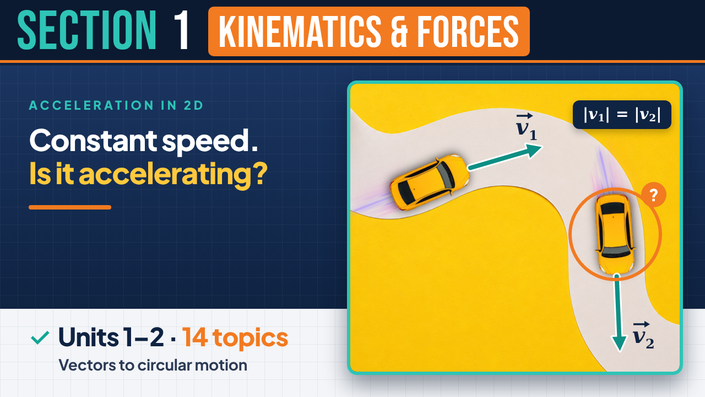
- Acceleration changing speed vs changing direction
- Independence of x and y motion under constant acceleration
1.5.5 Projectile Motion (Symmetric Launch)
- Defining assumptions of projectile motion
- Decomposing initial velocity into components
- Time of flight (symmetric case)
- Maximum height
- Range equation
- Angle for maximum range
1.5.6 Projectile Motion (Asymmetric Launch)
- Projectile launched from a height
- Horizontal launch from a cliff
- Velocity at any point along the trajectory
- Trajectory equation (y as function of x)
- Landing speed and angle
1.5.7 Relative Motion in Two Dimensions
- 2D vector velocity addition
- River-crossing problems
- Aircraft and wind problems
- Choosing reference frames in 2D
Unit2 Force and Translational Dynamics 9 topics · 22 lessons
2.1 Systems and Center of Mass 2 lessons
2.1.1 Defining a System
- What counts as a system
- Internal vs external forces
- Why system definition matters in problem-solving
- System boundary as a choice
2.1.2 Center of Mass
- Definition of center of mass
- Center of mass for two-particle and multi-particle systems
- Center of mass for symmetric objects
- Center of mass vs geometric center
- Motion of the center of mass under external forces
2.2 Forces and Free-Body Diagrams 3 lessons
2.2.1 Forces as Vectors
- Force as an interaction between objects
- Contact forces vs long-range forces
- Common force types (gravity, normal, friction, tension, applied, spring)
- Force as a vector quantity
2.2.2 Drawing Free-Body Diagrams
- Isolating the object of interest
- Drawing every force acting on the object
- Labeling forces correctly
- Choosing axes for the diagram
- Common student errors in FBDs
2.2.3 Resolving Forces and Net Force
- Decomposing forces along chosen axes
- Computing net force in each direction
- Magnitude and direction of the net force vector
2.3 Newton's Third Law 2 lessons
2.3.1 Action-Reaction Pairs
- Statement of Newton's Third Law
- Identifying action-reaction pairs
- Pairs act on different objects (key distinction)
- Forces in a pair are equal in magnitude, opposite in direction
2.3.2 Common Misconceptions about Third Law Pairs
- Why third-law pairs do not cancel out
- Distinguishing third-law pairs from balanced forces
- Examples that confuse students (horse and cart, person walking)
2.4 Newton's First Law 2 lessons
2.4.1 Inertia and the First Law
- Statement of Newton's First Law
- Concept of inertia
- Mass as a measure of inertia
- Equilibrium (static and dynamic)
2.4.2 Applying the First Law
- Identifying objects in equilibrium
- Equilibrium problems with multiple forces
- Why an object in motion stays in motion without net force
2.5 Newton's Second Law 3 lessons
2.5.1 F = ma
- Statement of Newton's Second Law
- Net force as the cause of acceleration
- Mass and acceleration relationship
- Units and direction
2.5.2 Solving Problems with the Second Law
- Single-object Second Law problems
- Choosing axes aligned with motion
- Inclined plane problems
- Connected objects (Atwood-style problems)
2.5.3 Multi-Body Problems
- Treating connected systems
- Internal vs external forces in multi-body systems
- Tension in connecting strings
- Acceleration constraints between connected objects
2.6 Gravitational Force 2 lessons
2.6.1 Weight and Gravitational Force
- Weight as F = mg
- Difference between mass and weight
- Direction of gravitational force
- Apparent weight in elevators
2.6.2 Universal Gravitation
- Newton's law of universal gravitation
- Inverse-square dependence on distance
- Gravitational field strength near Earth's surface
- Why g varies with altitude (qualitative)
2.7 Kinetic and Static Friction 3 lessons
2.7.1 Static Friction
- What static friction does
- Static friction as a self-adjusting force
- Maximum static friction
- Coefficient of static friction
- Threshold of slipping
2.7.2 Kinetic Friction
- Kinetic friction force
- Coefficient of kinetic friction
- Why kinetic friction is typically less than maximum static friction
- Direction of kinetic friction (opposite to motion)
2.7.3 Friction in Problem Solving
- Friction on horizontal surfaces
- Friction on inclined surfaces
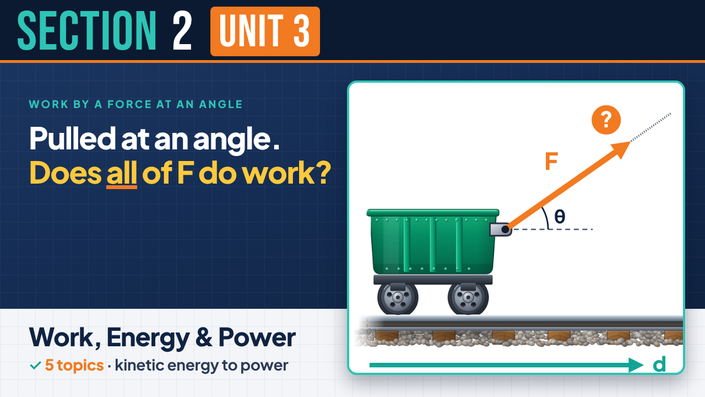
- Friction with applied force at an angle
- Common friction misconceptions
2.8 Spring Forces 2 lessons
2.8.1 Hooke's Law
- Spring force formula (F = -kx)
- Spring constant and stiffness
- Direction of spring force (restoring force)
- Equilibrium position vs displaced position
2.8.2 Springs in Problem Solving
- Springs in equilibrium problems
- Vertical springs with mass attached
- Series and parallel spring combinations (qualitative)
2.9 Circular Motion 3 lessons
2.9.1 Uniform Circular Motion
- Defining uniform circular motion
- Why velocity changes even at constant speed
- Period and frequency of circular motion
2.9.2 Centripetal Acceleration
- Direction of centripetal acceleration
- Centripetal acceleration formula (a = v²/r)
- Why "centripetal" describes a direction, not a force
2.9.3 Centripetal Force
- Net force as the source of centripetal acceleration
- Identifying which real force provides centripetal force
- Common scenarios (car on a curve, ball on a string, satellite, rollercoaster loop)
- Why "centrifugal force" is not a real force in inertial frames
Unit3 Work, Energy and Power 5 topics · 14 lessons
3.1 Translational Kinetic Energy 2 lessons
3.1.1 Defining Kinetic Energy
- Kinetic energy formula (½mv²)
- Kinetic energy as a scalar
- Why KE depends on speed squared
- Units of energy (joules)
3.1.2 Kinetic Energy in Problem Solving
- KE before and after collisions or events
- Comparing KE of different objects
- KE and reference frame dependence (qualitative)
3.2 Work 3 lessons
3.2.1 Defining Work
- Work as force times displacement (along force direction)
- W = Fd cos(θ) formula
- Work as a scalar
- Positive, negative, and zero work
- Work done by perpendicular forces
3.2.2 Work-Energy Theorem
- Statement of the work-energy theorem
- Net work as change in kinetic energy
- Applications to single-force and multi-force problems
3.2.3 Work Done by Variable Forces
- Work as area under a force-displacement graph
- Work done by a spring (½kx²)
- Comparing work of constant vs varying forces
3.3 Potential Energy 3 lessons
3.3.1 Gravitational Potential Energy
- GPE near Earth (mgh)
- Reference point dependence
- GPE as energy of position
3.3.2 Elastic Potential Energy
- Spring potential energy (½kx²)
- PE stored in stretched or compressed springs
- PE-displacement relationship for springs
3.3.3 Conservative vs Non-Conservative Forces
- What makes a force conservative
- Why friction is non-conservative
- Path independence of conservative forces (qualitative)
3.4 Conservation of Energy 4 lessons
3.4.1 Mechanical Energy Conservation
- Total mechanical energy (KE + PE)
- Conservation in absence of non-conservative forces
- Energy transformation between KE and PE
3.4.2 Energy Conservation with Friction
- Mechanical energy lost to thermal energy
- Work done by friction as energy "removed" from mechanical system
- Energy bookkeeping in problems with friction
3.4.3 Energy Bar Charts
- Drawing energy bar charts (KE, PE, thermal)
- Initial vs final state representation
- Bar charts as a problem-solving tool
3.4.4 Solving Conservation Problems
- Choosing initial and final states
- Choosing a reference for PE
- Pendulum, rollercoaster, and projectile problems
- Spring-mass energy problems
3.5 Power 2 lessons
3.5.1 Defining Power
- Power as rate of energy transfer
- Average power formula (W/t)
- Units of power (watts)
3.5.2 Instantaneous Power
- P = Fv formula
- Power for constant vs variable speed
- Real-world power examples (engines, lifts, athletes)
Unit4 Linear Momentum 4 topics · 10 lessons
4.1 Linear Momentum 2 lessons
4.1.1 Defining Linear Momentum
- Momentum formula (p = mv)
- Momentum as a vector
- Units of momentum
- Comparing momentum of different objects
4.1.2 Momentum vs Kinetic Energy
- Why two objects with same KE can have different momentum
- Why two objects with same momentum can have different KE
- When to use momentum vs energy
4.2 Change in Momentum and Impulse 3 lessons
4.2.1 Impulse
- Impulse as force times time
- Impulse formula (J = FΔt)
- Impulse as change in momentum (impulse-momentum theorem)
- Units of impulse
4.2.2 Force-Time Graphs
- Area under a force-time graph as impulse
- Constant vs varying force impulse problems
- Average force over a collision
4.2.3 Real-World Impulse Applications
- Crumple zones, airbags, padded surfaces
- Why extending collision time reduces force
- Catching a ball with bent knees
4.3 Conservation of Linear Momentum 2 lessons
4.3.1 Conservation Principle
- Statement of momentum conservation
- Closed/isolated system requirement
- Why net external force must be zero
4.3.2 Solving Conservation Problems
- Setting up before and after states
- Vector nature of conservation (component-wise)
- Recoil and explosion problems
4.4 Elastic and Inelastic Collisions 3 lessons
4.4.1 Types of Collisions
- Elastic collision definition (KE conserved)
- Inelastic collision definition (KE not conserved)
- Perfectly inelastic collision (objects stick)
4.4.2 Solving Collision Problems
- 1D elastic collision problems
- 1D inelastic collision problems
- Perfectly inelastic collisions and combined mass
- Energy loss in inelastic collisions
4.4.3 2D Collisions (Qualitative and Component-Based)
- Conservation of momentum in x and y separately
- Glancing collisions
- Splitting and recombination problems
Unit5 Torque and Rotational Dynamics 6 topics · 14 lessons
5.1 Rotational Kinematics 3 lessons
5.1.1 Angular Position and Displacement
- Angular position (θ) in radians
- Angular displacement (Δθ)
- Sign convention (counterclockwise positive)
- Radians vs degrees
5.1.2 Angular Velocity and Acceleration
- Average angular velocity (ω)
- Instantaneous angular velocity
- Angular acceleration (α)
- Rotational analogues to linear quantities
5.1.3 Rotational Kinematic Equations
- The four rotational kinematic equations
- Constant angular acceleration applications
- Solving rotational motion problems
5.2 Connecting Linear and Rotational Motion 2 lessons
5.2.1 Tangential Quantities
- Tangential velocity (v = rω)
- Tangential acceleration (aₜ = rα)
- Centripetal acceleration in rotational form (aᵧ = rω²)
- Relationship between linear and angular quantities
5.2.2 Rolling Connection (Preview)
- Rolling as combined translation and rotation
- Constraint v = rω for rolling without slipping
- Setting up problems that mix linear and rotational variables
5.3 Torque 2 lessons
5.3.1 Defining Torque
- Torque as rotational analogue of force
- Torque formula (τ = rF sin θ)
- Lever arm interpretation
- Direction of torque (sign convention)
5.3.2 Calculating Torque
- Torque from a single force at any angle
- Net torque from multiple forces
- Torque when force is perpendicular vs at an angle
- Choice of pivot point
5.4 Rotational Inertia 3 lessons
5.4.1 Moment of Inertia
- Moment of inertia as rotational mass
- Definition for a point mass (I = mr²)
- Why distance from axis matters more than mass
- Units of moment of inertia
5.4.2 Moments of Inertia for Common Shapes
- Solid disk, solid sphere, hollow sphere, rod, hoop
- Reading the I formula from a reference table
- Comparing rotational inertia for same mass, different shape
5.4.3 Parallel Axis Theorem (Qualitative)
- Effect of shifting the axis away from center of mass
- Why I increases when axis moves
- Conceptual applications
5.5 Rotational Equilibrium and Newton's First Law in Rotational Form 2 lessons
5.5.1 Rotational Equilibrium
- Net torque = 0 condition
- Static rotational equilibrium
- Combining translational and rotational equilibrium
5.5.2 Solving Equilibrium Problems
- Beam and bridge problems
- Choosing the pivot strategically
- Hanging signs, ladders, and seesaws
5.6 Newton's Second Law in Rotational Form 2 lessons
5.6.1 Net Torque and Angular Acceleration
- τ_net = Iα formula
- Comparison with F = ma
- Direction of angular acceleration
5.6.2 Solving Rotational Dynamics Problems
- Pulleys with mass
- Falling and rotating objects
- Combined translational and rotational systems
Unit6 Energy and Momentum of Rotating Systems 6 topics · 14 lessons
6.1 Rotational Kinetic Energy 2 lessons
6.1.1 Defining Rotational KE
- Rotational KE formula (½Iω²)
- Comparison with translational KE
- KE of rotating bodies as scalar
6.1.2 Total KE for Rolling Objects
- KE = ½mv² + ½Iω²
- Why rolling objects have more KE than sliding objects
- Distribution of KE between translation and rotation
6.2 Torque and Work 2 lessons
6.2.1 Work Done by a Torque
- Work-energy formula for rotation (W = τΔθ)
- Work-energy theorem for rotation
- Comparison with linear work-energy theorem
6.2.2 Power in Rotational Systems
- Rotational power (P = τω)
- Power applications (engines, drills, turbines)
6.3 Angular Momentum and Angular Impulse 2 lessons
6.3.1 Angular Momentum
- Angular momentum for a point particle (L = mvr sin θ)
- Angular momentum for a rotating rigid body (L = Iω)
- Direction and sign of angular momentum
6.3.2 Angular Impulse
- Angular impulse formula (τΔt)
- Angular impulse as change in angular momentum
- Comparison with linear impulse
6.4 Conservation of Angular Momentum 2 lessons
6.4.1 Conservation Principle
- When angular momentum is conserved
- Net external torque = 0 condition
6.4.2 Applications of Angular Momentum Conservation
- Spinning skater pulling arms in
- Diver tucking and untucking
- Collisions involving rotation
- Astronomical applications (qualitative)
6.5 Rolling 3 lessons
6.5.1 Rolling Without Slipping
- v = rω constraint
- Static friction's role in rolling
- Why rolling friction is not a separate AP topic
6.5.2 Rolling Down Inclines
- Energy conservation for rolling objects
- Why a hollow object rolls slower than a solid one
- Comparing race-down-incline outcomes for different shapes
6.5.3 Slipping vs Rolling
- When an object slips instead of rolls
- Transition between slipping and rolling (qualitative)
6.6 Motion of Orbiting Satellites 3 lessons
6.6.1 Circular Orbits
- Gravitational force as centripetal force
- Orbital speed formula
- Orbital period
6.6.2 Energy of Orbits
- KE and PE in circular orbit
- Total mechanical energy of an orbit
- Why total energy is negative for bound orbits (qualitative)
6.6.3 Orbital Applications
- Satellites and the ISS
- Geostationary orbits
- Comparing orbits at different altitudes
Unit7 Oscillations 4 topics · 11 lessons
7.1 Defining Simple Harmonic Motion 2 lessons
7.1.1 What Makes Motion Simple Harmonic
- Restoring force proportional to displacement
- Equilibrium position
- Why SHM is sinusoidal in time
7.1.2 Examples of SHM
- Mass on a spring
- Simple pendulum (small angles)
- Why other oscillations may not be SHM
7.2 Frequency and Period of SHM 3 lessons
7.2.1 Period and Frequency Definitions
- Period (T) and frequency (f) relationship
- Units of period and frequency
- Angular frequency (ω = 2πf)
7.2.2 Period of Spring-Mass System
- T = 2π√(m/k) formula
- Why period does not depend on amplitude
- Effect of mass and spring constant on period
7.2.3 Period of a Pendulum
- T = 2π√(L/g) formula
- Small angle approximation
- Why pendulum period does not depend on mass
- Effect of length and g on period
7.3 Representing and Analyzing SHM 3 lessons
7.3.1 Position, Velocity, and Acceleration in SHM
- Position as sinusoidal function of time
- Velocity as derivative behavior (qualitative)
- Acceleration relationship (a = -ω²x)
7.3.2 Graphs of SHM
- Position-time graph
- Velocity-time graph
- Acceleration-time graph
- Phase relationships between x, v, a
7.3.3 Amplitude, Phase, and Equilibrium
- Amplitude as maximum displacement
- Phase constant
- Where speed is maximum vs zero
- Where acceleration is maximum vs zero
7.4 Energy of Simple Harmonic Oscillators 3 lessons
7.4.1 KE and PE in SHM
- KE varies with position
- PE varies with position
- Energy at equilibrium vs at amplitude
- Total energy as constant (½kA²)
7.4.2 Energy Graphs and Bar Charts
- KE vs position graph
- PE vs position graph
- Total energy line
- Bar charts at different positions in the cycle
7.4.3 Energy in Spring-Mass and Pendulum Systems
- Spring-mass energy expressions
- Pendulum energy expressions
- Maximum speed from energy conservation
Unit8 Fluids 4 topics · 11 lessons
8.1 Internal Structure and Density 2 lessons
8.1.1 States of Matter and Fluid Behavior
- Solids, liquids, and gases
- Why liquids and gases are both fluids
- Compressibility differences
8.1.2 Density
- Density formula (ρ = m/V)
- Units of density
- Density of common substances
- Density and floating/sinking (qualitative preview)
8.2 Pressure 3 lessons
8.2.1 Defining Pressure
- Pressure as force per area (P = F/A)
- Units of pressure (pascals)
- Pressure as a scalar in fluids
8.2.2 Pressure in a Fluid Column
- Pressure varies with depth (P = P₀ + ρgh)
- Atmospheric pressure
- Gauge pressure vs absolute pressure
8.2.3 Pascal's Principle
- Statement of Pascal's principle
- Hydraulic systems
- Force multiplication in hydraulics
8.3 Fluids and Newton's Laws 3 lessons
8.3.1 Buoyant Force
- Origin of buoyancy from pressure differences
- Archimedes' principle
- Buoyant force formula (F_b = ρ_fluid · V_displaced · g)
8.3.2 Floating, Sinking, and Apparent Weight
- Condition for floating
- Condition for sinking
- Fraction submerged for floating objects
- Apparent weight of submerged objects
8.3.3 Newton's Laws in Fluids
- Free-body diagrams in fluids
- Equilibrium of floating and submerged objects
- Acceleration of objects in fluids
8.4 Fluids and Conservation Laws 3 lessons
8.4.1 Continuity Equation
- Conservation of mass in fluid flow
- Continuity equation (A₁v₁ = A₂v₂)
- Why narrower pipes mean faster flow
8.4.2 Bernoulli's Equation
- Energy conservation in flowing fluids
- Bernoulli's equation form
- Pressure, height, and speed trade-offs
8.4.3 Applications of Bernoulli
- Lift on an airplane wing (qualitative)
- Venturi effect
- Fluid speed vs pressure intuitions
- Common Bernoulli misconceptions
*Class periods and AP Exam weighting are the College Board’s official figures (45-minute periods, full academic year). They’re shown here so you can see how each unit maps to the real AP Physics 1 exam.
Why grab this course?
- Aligned to the 2026 AP Physics 1 CED
- Mind maps replace 200 pages of textbook
- Simulations let you see the physics
- Made by a physics educator, not an AI


